How picture puzzles measure reasoning
Why matrix puzzles work across languages, and the five puzzle types used in this test.
5 min read
Most of the questions in our test contain no words at all. That is a deliberate choice with a long history behind it.
The idea behind matrix puzzles
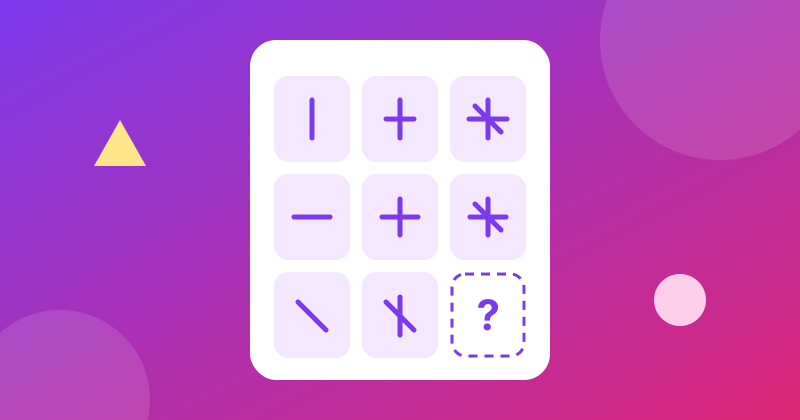
In 1938 the British psychologist John C. Raven published the Progressive Matrices: grids of abstract shapes with one piece missing. To find the missing piece, you have to notice how the shapes change across each row and down each column, then apply those rules to the empty cell. Nothing in the puzzle depends on vocabulary, schooling in a particular language, or cultural knowledge, which is why matrix tests are still used around the world.
No test is completely "culture-free" — familiarity with test-taking and with abstract diagrams still helps — but picture puzzles come much closer than verbal ones. They are also strongly related to the general factor g, which makes them one of the most efficient ways to estimate reasoning ability in a short time.
The five puzzle types in this test
1. Number sequences
A row of numbers follows a hidden rule — adding, multiplying, alternating, or combining two steps. The trick is to look at the differences between neighbours, then the differences of those differences.
2. Matrices
A 3×3 grid where each row and column changes in a consistent way: the number of shapes, their type, their rotation, or their shading. Often two rules run at once, for example "one more shape per column" and "a different shape per row".
3. Mental rotation
Which option is the same figure, only turned? The wrong answers are usually mirror images. Pick one distinctive corner of the figure and follow it as you rotate the shape in your head.
4. Odd one out
Four or more figures share a property and one does not. The shared property is rarely the most obvious one, so if the first difference you notice applies to two figures, keep looking.
5. Symbol equations and number grids
Shapes stand for numbers, or numbers in a grid are linked by an arithmetic rule. Solve the simplest line first and substitute the value into the others, just as you would with a system of equations.
Why the puzzles get harder
Questions are ordered roughly from easy to hard, and harder questions carry more weight in your score. Early puzzles use a single rule; later ones combine two or three. That structure lets a 20-question test separate people across a wide range of ability without becoming tiresome.