What is IQ, really?
What an IQ score measures, why the average is 100, and what it cannot tell you.
4 min read
IQ stands for intelligence quotient. It is a number that summarizes how well a person performs on a set of reasoning tasks compared with other people of the same age. That last part matters most: an IQ score is not a measurement like height or weight, it is a position in a crowd.
Why the average is always 100
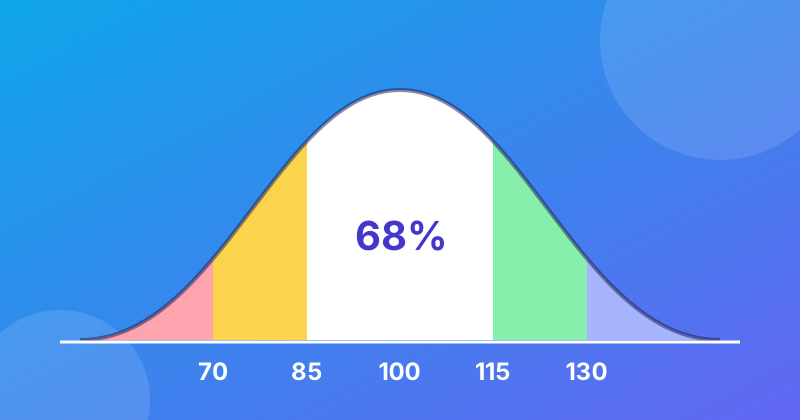
Modern tests are built so that the average score in a reference group is set to 100 and the spread (the standard deviation) is set to 15. A score of 115 therefore means "one standard deviation above average", which is higher than about 84% of people. A score of 85 is one standard deviation below, higher than about 16%.
Because the scale is defined this way, a test has to be normed: given to a large, representative group so the publisher knows what "average" looks like. When a test is re-normed years later, the raw number of correct answers needed for 100 often changes.
What IQ tests actually measure
Most tests combine several kinds of tasks:
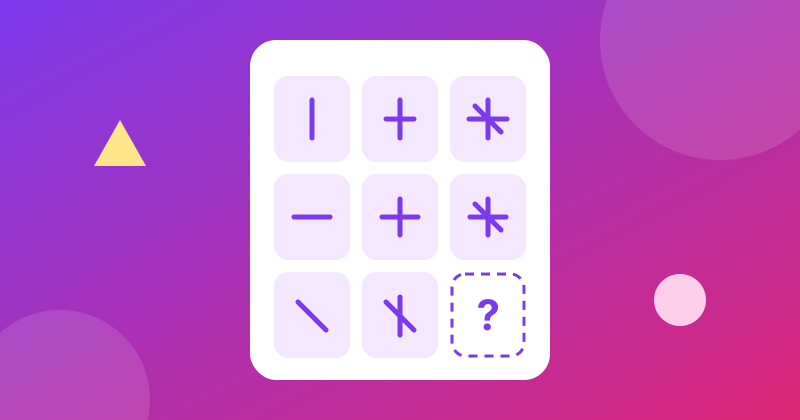
- Fluid reasoning — spotting rules in unfamiliar patterns, like the matrix puzzles in our test.
- Working memory — holding and manipulating information for a few seconds.
- Processing speed — doing simple tasks quickly and accurately.
- Verbal and general knowledge — vocabulary and facts learned over time, often called crystallized ability.
People who do well on one kind of task tend to do well on the others. Psychologists call this shared factor g, for general intelligence. It is one of the most replicated findings in psychology, although what causes it is still debated.
What an IQ score cannot tell you
IQ predicts some things reasonably well, such as how easily someone learns new academic material. But it says little about creativity, character, motivation, social skill or practical wisdom, and it is only one influence on success among many. A single score also has a margin of error: even a professionally administered test is usually reported with a range of about ±5 points.
Where an online test fits
A short online test like ours is a quick, language-free estimate of the reasoning part of IQ. It is fun, it can show you which kinds of puzzles you find easy or hard, and it lets you compare yourself with other test takers. It is not a clinical assessment. If you need an official score — for school placement or a diagnosis — that requires a licensed psychologist and a standardized test such as the WAIS or Stanford-Binet.