A short history of IQ tests
From a Paris school project in 1905 to the Flynn effect: how intelligence testing took shape.
4 min read
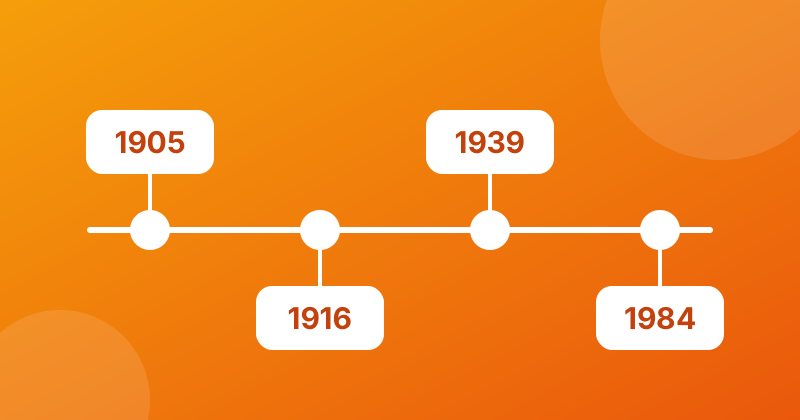
1905 — Binet and Simon
The French government asked psychologist Alfred Binet to find a way to identify children who needed extra help at school. With Théodore Simon he built a series of tasks of increasing difficulty and noted the age at which typical children could pass each one. A child's "mental age" could then be compared with their actual age. Binet himself warned that the scale measured current performance, not a fixed, inborn quantity.
1912 — The word "quotient"
German psychologist William Stern proposed dividing mental age by actual age. Multiplied by 100, this ratio IQ gave the familiar number: a 10-year-old performing like a typical 12-year-old would score 120.
1916 — Stanford-Binet
Lewis Terman at Stanford University adapted Binet's scale for American children and popularized the term IQ. The Stanford-Binet, revised many times since, is still in use today.
1917 — Testing at scale
During the First World War, the US Army tested well over a million recruits with the Army Alpha (written) and Army Beta (pictorial, for those who could not read English) tests. This was the first mass use of intelligence tests, and also an early example of how results could be misused to support prejudiced conclusions about groups.
1939 — Wechsler and the deviation IQ
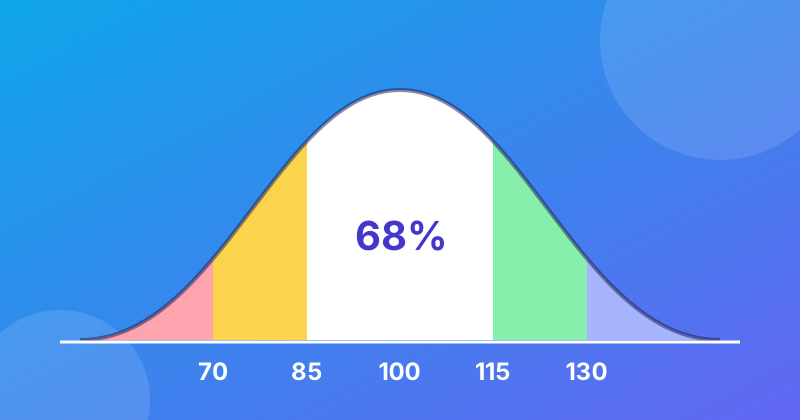
Ratio IQ breaks down for adults: mental age stops rising in early adulthood, but actual age keeps going. David Wechsler solved this by comparing each person with others of the same age and expressing the result on a scale with a mean of 100 and a standard deviation of 15. This deviation IQ is how virtually every modern test is scored, including ours.
1984 — The Flynn effect
Political scientist James Flynn documented that raw scores on IQ tests had been rising across many countries throughout the 20th century — on the order of about three points per decade. Tests had to be re-normed regularly to keep the average at 100. Better nutrition, more schooling and a more abstract everyday environment are among the proposed explanations. In some countries the rise has slowed or reversed in recent decades.
Today
Modern tests such as the WAIS and WISC report several index scores — verbal comprehension, perceptual reasoning, working memory, processing speed — alongside the full-scale IQ, reflecting a century of research showing that intelligence has both a general factor and more specific abilities.