How to get an accurate result
Practical tips for setting up, pacing yourself and solving puzzles without overthinking.
3 min read
An IQ test is only as useful as the conditions you take it in. These tips will not inflate your score, but they will make sure the score reflects what you can actually do.
Before you start
- Set aside 20 uninterrupted minutes. The timer cannot be paused. Put your phone on silent and close other tabs.
- Use a screen you can see clearly. The puzzles work on phones, but fine details are easier on a larger screen.
- Take it when you are rested. Late at night or right after a long day is not a fair test of yourself.
- No help. Calculators, search engines or a friend looking over your shoulder will give you a number that is not yours.
Pacing
You have 20 minutes for 20 puzzles — an average of one minute each. Early puzzles should take well under a minute, which banks time for the harder ones at the end. If you are stuck for more than two minutes, pick your best guess, move on, and come back if time allows. You can change any answer before submitting.
Solving strategies
Look for one change at a time
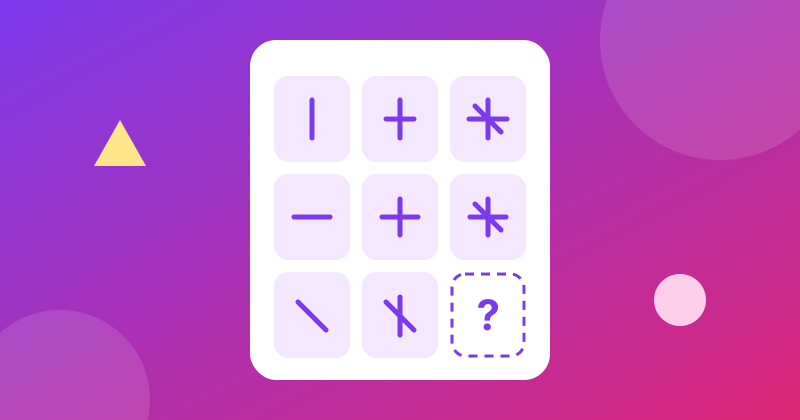
In a matrix, compare the first two cells of a row and list everything that changes: count, shape, size, rotation, shading. Then check which of those changes continue to the third cell.
Check rows and columns
Many puzzles have one rule across rows and a different rule down columns. If a rule seems to work across but not down, look for a second rule.
Eliminate options
Even if you cannot see the full rule, you can often rule out options that break part of it. Choosing between two candidates is much easier than six.
For numbers, write the differences
Under a number sequence, note the gap between each pair. If the gaps are not constant, look at their ratio, or at whether two separate sequences are interleaved.
After the test
Look at your four ability scores to see which kinds of puzzles cost you points. The correct answers are not shown, because the same puzzles are drawn again for other people, and published answers would make everyone's results meaningless. If you retake the test, remember that familiarity with the puzzle types raises scores — compare results with that in mind.